
The decision died in the chat
The reasoning behind every choice ended up in a conversation nobody archives. Two weeks later, not even the person who asked can reconstruct the reasoning — and the next agent starts from zero.
AI development harness
The control plane for AI-assisted development: see, govern and audit what agents do in your code — specified beforehand, traceable while it runs, auditable afterward. On the repository you already have, with the agent you already use.
The problem
Adopting AI agents multiplied the volume of code your team ships. What didn’t keep up was the ability to answer what was decided, why, and who approved it.
The reasoning behind every choice ended up in a conversation nobody archives. Two weeks later, not even the person who asked can reconstruct the reasoning — and the next agent starts from zero.
The agent delivers what it understood, not what was agreed. Without an acceptance criterion written beforehand, the drift only surfaces at review — when it surfaces at all.
Who ran what, in which repository, with which agent, under which approval? Without an answer, there’s no honest review — let alone an audit.
How it works
In engineering, a test harness runs under controlled conditions, collects what happened and checks it against what was expected. Spaccy applies that shape to the agents’ work — and all you need are the commands below.
You describe what you want; Spaccy turns it into an analysis, a proposal and a specification versioned in your repository. When the problem isn’t clear yet, the study comes before the solution — and the acceptance criteria are written before the first line is generated. The agent gets a contract, not a hunch.
/analysis/proposal/ai-spec
The implementation runs in an isolated copy of your working tree, and nothing gets written without your approval. At every step, progress is read from the repository and shown in the cockpit — nobody has to update a status field.
/implement/pipeline
Every delivery is reviewed against its own specification, decisions become architecture records, and whatever’s left over becomes a follow-up with an owner and a due date. Six months later, the answer to “why is this like this?” is sitting in the repository.
/review/followup
The cockpit
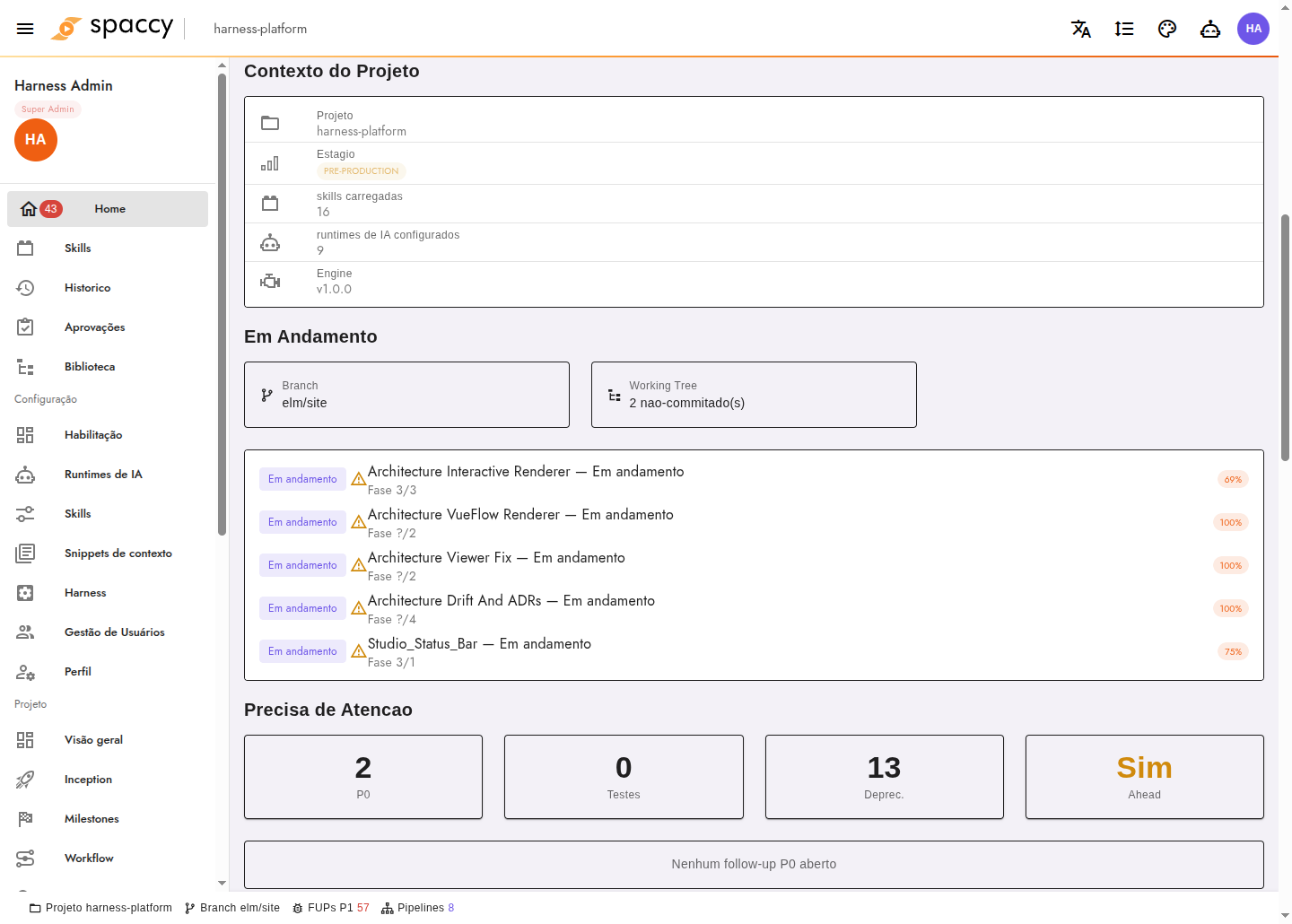
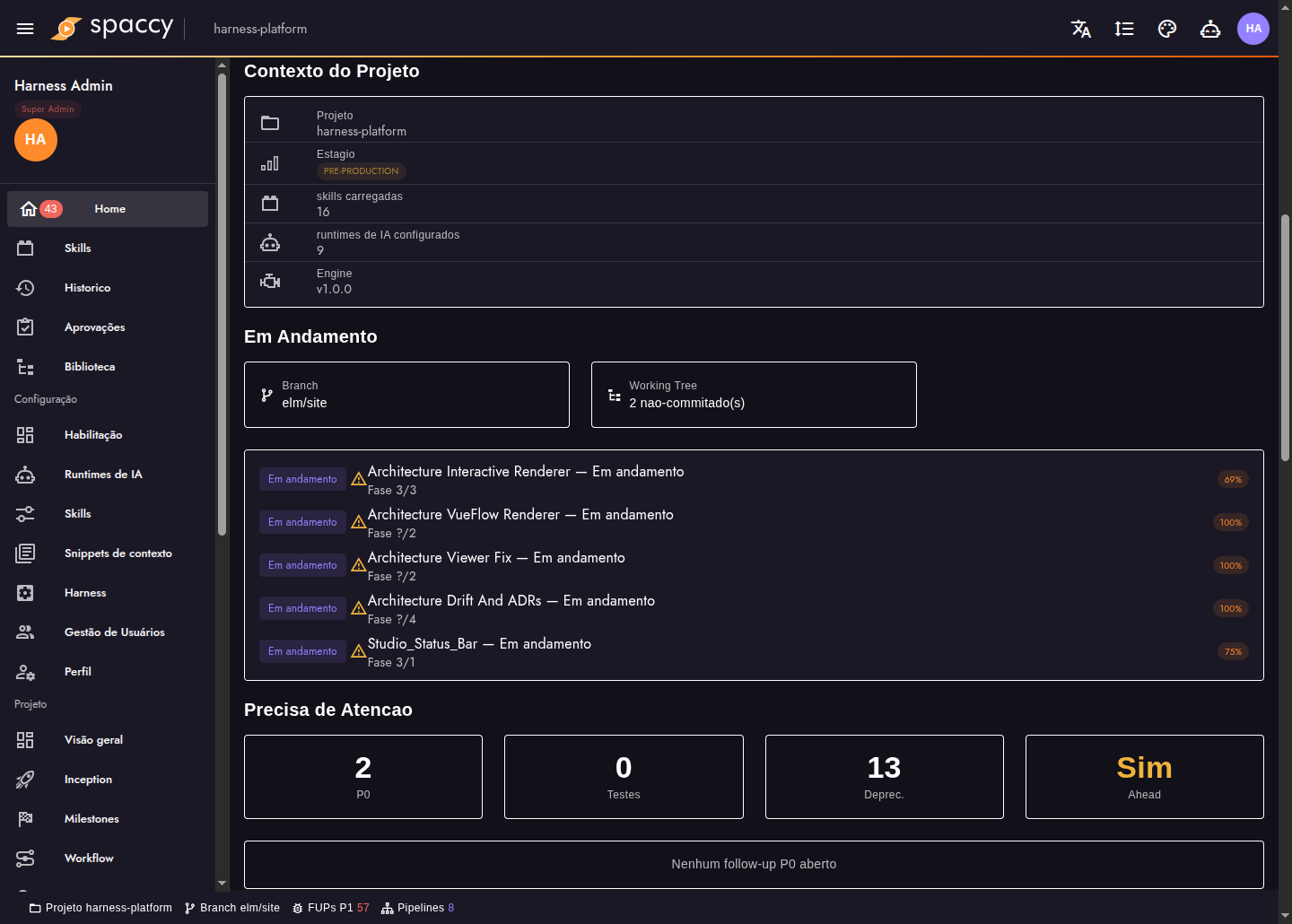
Spaccy Studio reads your repository and shows the real state of the work — with nobody filling in a status field, with no meeting needed to find out where each thing stalled.
Bring your own agent
Eleven supported runtimes today, behind the same interface. Switching agents tomorrow doesn’t cost you your process, and your process doesn’t stay hostage to one model vendor.
Why Spaccy
Spaccy doesn’t compete with your agent — it orchestrates and watches it. Eleven runtimes behind the same interface: switch models or vendors without losing your process, your history or your specs.
Human approval before every write, role-based permissions, deprecations with a due date, and a trail of who ran what. The process is executed by the tool — not remembered by a person at the end of a long day.
Critical steps run on deterministic engines: when context or a precondition is missing, the flow stops and states what’s missing. That’s the difference between a reproducible process and “write the prompt and hope for the best.”
Specs, decisions, follow-ups and history version alongside the code, readable by humans and by machines. Nothing leaves your machine, and there’s no lock-in: if you stop using Spaccy, the project’s memory stays yours.
You don’t need to start from zero. Spaccy scans the documentation and code of a project already in flight, builds the context map, and reconstructs the specifications of what’s already been built — all anchored to the real code.
Technical and user manuals, use cases, team training and narrated video, generated from the project itself — and refreshable when it changes. Documentation stops being the debt nobody pays down.
Explore
The workflow from the inside, the copilot inside your own application, how the process is dialed to your team, security built into the flow, the documentation Spaccy writes for you, the layered view of your system, and the governance of what agents do — each on its own page.
The four-command cycle, customization by team and by person, and requirement-to-test traceability once it’s done.
See the workflow from the insideThe copilot inside the application you’re building: sees the screen, the error and the element you pointed at — and reaches the file that generated it.
See the copilot in the appThree rigor tiers to match ceremony to risk, and three methodologies that speak your team’s language — agile, enterprise or standard.
See how the process is dialedThreat and privacy modeling at design time, code audit, a scan of the live application, and a deterministic gate before release.
See security in the flowManual, use cases, training, video and deep explanations — generated from your own project, not written by hand.
See what Spaccy writes for youThe architecture, the domain and the decisions of your system, extracted from the code and navigable in layers — from the diagram down to the line.
See the vision of your systemHuman approval before every write, no lost work, and a full trail of who ran what.
See how the process becomes visiblePre-launch
Public installation is not available yet. If you want to try it before everyone else, request early access — we'll let you know if you're selected.
If you're selected, you'll receive the installation commands by email.